Introduction
An enteric coated tablet is tested in two stages, not one. It sits in acid first, where it is supposed to stay closed, then moves into a neutral buffer, where it is supposed to open. A failure at either stage means the coating did not do the one job it exists to do. The tablet either released its drug too early, before it left the stomach, or it failed to release drug at all once it reached the intestine.
Both failures trace back to the coating itself, but for opposite reasons. An acid stage failure usually means the coating let something through it should have blocked. A buffer stage failure usually means the coating kept blocking something it should have released. Treating both as the same problem and reaching for the same fix is where most troubleshooting goes wrong.
At Vikram Thermo, we work with formulators through exactly this kind of failure investigation as a tablet coating polymer manufacturer supplying enteric coating polymer systems. This article walks through what actually happens during the two stage test, the distinct causes behind each type of failure and how to tell which one is actually happening before changing anything in the formulation.
What the Two Stage Test Actually Checks
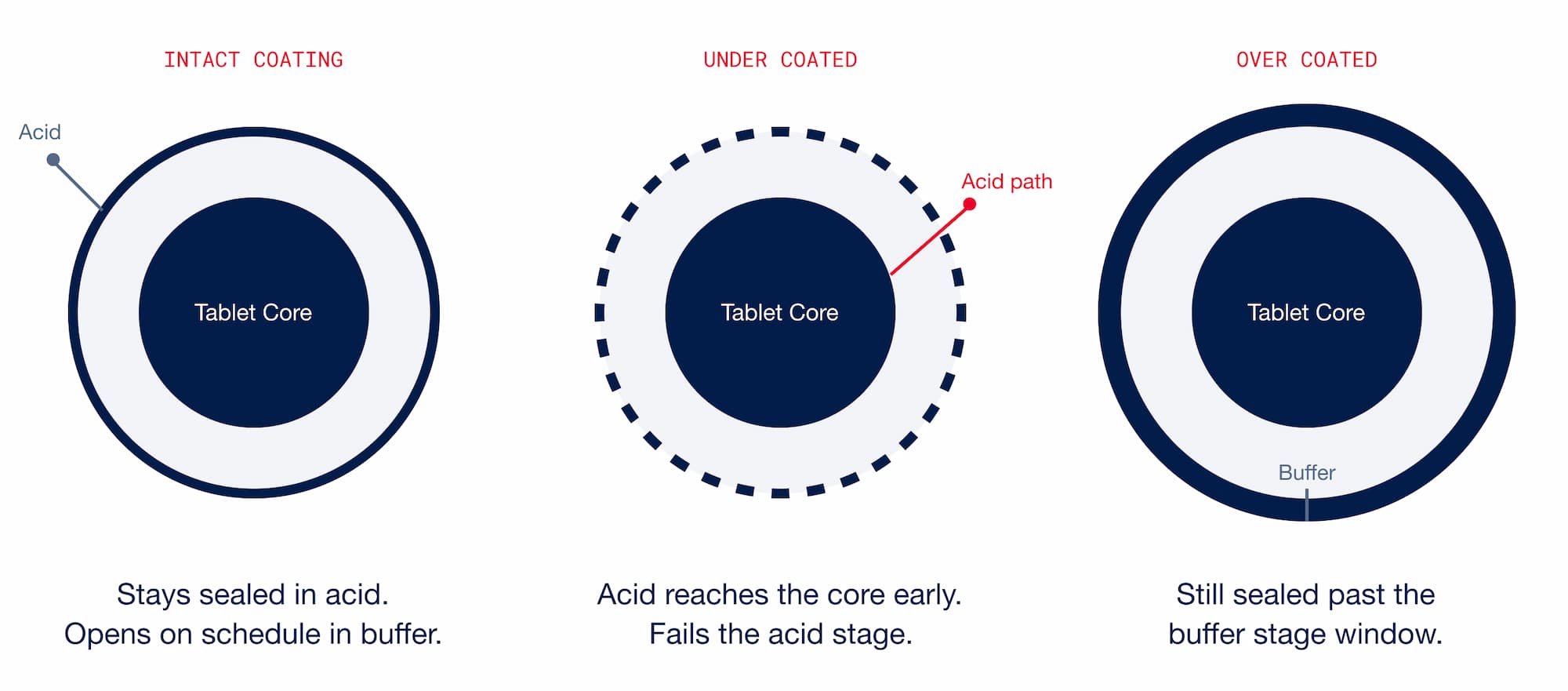
The first stage places the tablet in 0.1N hydrochloric acid, simulating stomach conditions, typically for two hours. A properly coated tablet should show little to no drug release and no visible disintegration during this stage, demonstrating real acid resistance rather than a passing average across a batch. The coating's entire function during this window is to stay closed.
The second stage transfers the tablet into a pH 6.8 phosphate buffer, simulating the intestine. Here the coating is expected to dissolve or become permeable within a defined window, releasing the drug within the specification's time limit. A coating engineered around the wrong pH threshold, or applied too thickly, can pass the first stage cleanly and still fail the second.
These are not variations of the same requirement. They are opposite requirements placed on the same film. A coating that gets one wrong is not automatically wrong about the other.
Why Acid Stage Failures Happen
Under coating.
If the applied weight gain falls short of what the polymer needs to form a continuous, defect free film, acid can penetrate through thin or incomplete spots long before the two hour window ends.
Cracking and pinholes.
Physical defects in the film, from coating process conditions, compression stress on printed or debossed tablets, or rough handling during packaging, create direct pathways for acid to reach the core.
Incomplete curing.
Many enteric polymers need a curing step after spraying to fully develop film integrity. A film that looks complete on visual inspection can still be functionally immature if curing time or temperature fell short.
Plasticizer issues.
Too little plasticizer leaves a brittle film prone to cracking under any mechanical stress. Too much can interfere with how the film sets, leaving it permeable in ways that are not visible without testing.
Why Buffer Stage Failures Happen
Over coating.
A film applied well beyond the target weight gain protects reliably in acid but can take longer than specified to dissolve or become permeable once it reaches the buffer stage, pushing the tablet past its release window.
Wrong pH threshold.
Enteric polymers are engineered to dissolve above a specific pH. A polymer selected for a higher threshold than the test buffer, or higher than where the drug actually needs to release in the body, will simply not open on schedule.
Permeability transition issues.
Some films rely on a swelling or ionization change to become permeable. If the underlying tablet core does not support that transition, from moisture uptake behavior to core hardness, the coating can remain functionally closed even after its chemistry has technically shifted.
Diagnosing Which Failure You Actually Have
Common Challenges
Treating every dissolution failure as a coating thickness problem.
Thickness explains under coating and over coating, but not a polymer selected for the wrong pH threshold, which no amount of added coating weight will fix.
Testing only the average, not the distribution.
A batch average weight gain within specification can still contain individual tablets thin enough to fail acid stage, since the average hides tablet to tablet variation.
Assuming a passed visual inspection means an intact film.
Cracks and pinholes small enough to escape visual inspection are often exactly the size that lets acid through during a two hour exposure.
Changing the polymer before confirming the actual failure point.
A formulator who sees a dissolution failure and immediately switches enteric systems sometimes discovers, after the fact, that the original polymer was correct and the coating process was the actual problem.
Formulation Insights
A dissolution failure investigation should start by identifying which stage actually failed before touching the formulation. As a tablet coating polymer manufacturer working across enteric coating polymer and pharmaceutical coating polymers more broadly, we typically ask for both stage results separately, not just a pass or fail summary, since the two stages point toward completely different root causes.
Pulling a small sample for cross sectional inspection, even a simple cut and visual check under magnification, often reveals whether the coating is thin, cracked or intact well before a full root cause investigation is needed. As a GMP excipient manufacturer, pharmaceutical excipient manufacturer in India and pharma raw material supplier in India, we support this kind of diagnostic work directly on any film coating polymer for tablets we supply, since functional excipients pharmaceutical teams rely on can still fail in a specific formulation even when the underlying aqueous film coating system is chosen correctly, if the tablet core or process conditions differ.
FAQ
1. Can a coating pass acid stage testing and still be defective?
Yes. A coating can be intact enough to block acid for two hours while still being too thick, or built from a polymer with too high a pH threshold, to open correctly during the buffer stage.
2. Is a dissolution testing failure always a coating problem?
Not always, though it usually traces back to the coating one way or another. Tablet core hardness, porosity and disintegration behavior can also affect how the coating performs, particularly during the buffer stage transition.
3. How much weight gain variation is enough to cause an acid stage failure?
There is no single number, since it depends on the specific polymer and target thickness, but even small pockets of under coating on individual tablets, invisible in a batch average, are a common cause.
4. Should every acid stage failure lead to increasing the coating weight?
No. Increasing weight gain fixes under coating, but if the actual cause is cracking, incomplete curing or a plasticizer issue, added weight will not resolve it and can introduce a buffer stage failure instead.
5. What is the fastest way to narrow down which stage is actually failing?
Request the acid stage and buffer stage results as separate data points rather than a combined pass or fail outcome, then pair that with a simple cross sectional inspection of a few tablets before assuming a formulation change is needed.
Conclusion
An enteric coating has two separate jobs, staying closed in acid and opening on schedule in buffer. A dissolution failure almost always points to just one of them, not both. Diagnosing which stage actually failed, rather than defaulting to a thicker coating or a different polymer, is what separates a fix that works from one that trades one failure for the other.
Talk to Us About Your Dissolution Result.
Tell us which stage of testing is failing and what enteric system you are currently using. We will help you narrow down whether the coating, the core or the process is the actual source.
Write to us at contact@vikramthermo.com

Introduction
An enteric coated tablet is tested in two stages, not one. It sits in acid first, where it is supposed to stay closed, then moves into a neutral buffer, where it is supposed to open. A failure at either stage means the coating did not do the one job it exists to do. The tablet either released its drug too early, before it left the stomach, or it failed to release drug at all once it reached the intestine.
Both failures trace back to the coating itself, but for opposite reasons. An acid stage failure usually means the coating let something through it should have blocked. A buffer stage failure usually means the coating kept blocking something it should have released. Treating both as the same problem and reaching for the same fix is where most troubleshooting goes wrong.
At Vikram Thermo, we work with formulators through exactly this kind of failure investigation as a tablet coating polymer manufacturer supplying enteric coating polymer systems. This article walks through what actually happens during the two stage test, the distinct causes behind each type of failure and how to tell which one is actually happening before changing anything in the formulation.
What the Two Stage Test Actually Checks
The first stage places the tablet in 0.1N hydrochloric acid, simulating stomach conditions, typically for two hours. A properly coated tablet should show little to no drug release and no visible disintegration during this stage, demonstrating real acid resistance rather than a passing average across a batch. The coating's entire function during this window is to stay closed.
The second stage transfers the tablet into a pH 6.8 phosphate buffer, simulating the intestine. Here the coating is expected to dissolve or become permeable within a defined window, releasing the drug within the specification's time limit. A coating engineered around the wrong pH threshold, or applied too thickly, can pass the first stage cleanly and still fail the second.
These are not variations of the same requirement. They are opposite requirements placed on the same film. A coating that gets one wrong is not automatically wrong about the other.
Why Acid Stage Failures Happen
Under coating.
If the applied weight gain falls short of what the polymer needs to form a continuous, defect free film, acid can penetrate through thin or incomplete spots long before the two hour window ends.
Cracking and pinholes.
Physical defects in the film, from coating process conditions, compression stress on printed or debossed tablets, or rough handling during packaging, create direct pathways for acid to reach the core.
Incomplete curing.
Many enteric polymers need a curing step after spraying to fully develop film integrity. A film that looks complete on visual inspection can still be functionally immature if curing time or temperature fell short.
Plasticizer issues.
Too little plasticizer leaves a brittle film prone to cracking under any mechanical stress. Too much can interfere with how the film sets, leaving it permeable in ways that are not visible without testing.
Why Buffer Stage Failures Happen
Over coating.
A film applied well beyond the target weight gain protects reliably in acid but can take longer than specified to dissolve or become permeable once it reaches the buffer stage, pushing the tablet past its release window.
Wrong pH threshold.
Enteric polymers are engineered to dissolve above a specific pH. A polymer selected for a higher threshold than the test buffer, or higher than where the drug actually needs to release in the body, will simply not open on schedule.
Permeability transition issues.
Some films rely on a swelling or ionization change to become permeable. If the underlying tablet core does not support that transition, from moisture uptake behavior to core hardness, the coating can remain functionally closed even after its chemistry has technically shifted.
Diagnosing Which Failure You Actually Have
Common Challenges
Treating every dissolution failure as a coating thickness problem.
Thickness explains under coating and over coating, but not a polymer selected for the wrong pH threshold, which no amount of added coating weight will fix.
Testing only the average, not the distribution.
A batch average weight gain within specification can still contain individual tablets thin enough to fail acid stage, since the average hides tablet to tablet variation.
Assuming a passed visual inspection means an intact film.
Cracks and pinholes small enough to escape visual inspection are often exactly the size that lets acid through during a two hour exposure.
Changing the polymer before confirming the actual failure point.
A formulator who sees a dissolution failure and immediately switches enteric systems sometimes discovers, after the fact, that the original polymer was correct and the coating process was the actual problem.
Formulation Insights
A dissolution failure investigation should start by identifying which stage actually failed before touching the formulation. As a tablet coating polymer manufacturer working across enteric coating polymer and pharmaceutical coating polymers more broadly, we typically ask for both stage results separately, not just a pass or fail summary, since the two stages point toward completely different root causes.
Pulling a small sample for cross sectional inspection, even a simple cut and visual check under magnification, often reveals whether the coating is thin, cracked or intact well before a full root cause investigation is needed. As a GMP excipient manufacturer, pharmaceutical excipient manufacturer in India and pharma raw material supplier in India, we support this kind of diagnostic work directly on any film coating polymer for tablets we supply, since functional excipients pharmaceutical teams rely on can still fail in a specific formulation even when the underlying aqueous film coating system is chosen correctly, if the tablet core or process conditions differ.
FAQ
1. Can a coating pass acid stage testing and still be defective?
Yes. A coating can be intact enough to block acid for two hours while still being too thick, or built from a polymer with too high a pH threshold, to open correctly during the buffer stage.
2. Is a dissolution testing failure always a coating problem?
Not always, though it usually traces back to the coating one way or another. Tablet core hardness, porosity and disintegration behavior can also affect how the coating performs, particularly during the buffer stage transition.
3. How much weight gain variation is enough to cause an acid stage failure?
There is no single number, since it depends on the specific polymer and target thickness, but even small pockets of under coating on individual tablets, invisible in a batch average, are a common cause.
4. Should every acid stage failure lead to increasing the coating weight?
No. Increasing weight gain fixes under coating, but if the actual cause is cracking, incomplete curing or a plasticizer issue, added weight will not resolve it and can introduce a buffer stage failure instead.
5. What is the fastest way to narrow down which stage is actually failing?
Request the acid stage and buffer stage results as separate data points rather than a combined pass or fail outcome, then pair that with a simple cross sectional inspection of a few tablets before assuming a formulation change is needed.
Conclusion
An enteric coating has two separate jobs, staying closed in acid and opening on schedule in buffer. A dissolution failure almost always points to just one of them, not both. Diagnosing which stage actually failed, rather than defaulting to a thicker coating or a different polymer, is what separates a fix that works from one that trades one failure for the other.
Talk to Us About Your Dissolution Result.
Tell us which stage of testing is failing and what enteric system you are currently using. We will help you narrow down whether the coating, the core or the process is the actual source.
Write to us at contact@vikramthermo.com


- Venue:
- Date:
- Booth:
- Time:
- Hosted by:
- Venue:
- Date:
- Booth:
- Time:
- Hosted by: