Introduction
A bitter active ingredient does not become pleasant because a formulation is otherwise well designed. It becomes tolerable only if something physically or chemically stands between the drug and the tongue during the brief window before swallowing. Three techniques do this work in pharmaceutical formulations, ion exchange resins, film coating and granulation. Each solves the problem through a completely different mechanism.
Choosing between them is not a matter of picking whichever technique a formulator has used before. Each one depends on a different property of the API, works reliably with a different set of dosage forms and fails in a different way when applied to the wrong product. A resin that works beautifully for one bitter compound can do nothing at all for another, not because the resin is inferior, but because the underlying chemistry of the two APIs is not comparable.
At Vikram Thermo, we supply materials across all three routes, taste masking resin, functional coating polymer and granulation grade excipients. This article sets out how each technique actually works, what determines whether it will succeed on a specific API and how the three compare directly against each other.
How Each Technique Actually Works
Ion exchange resins.
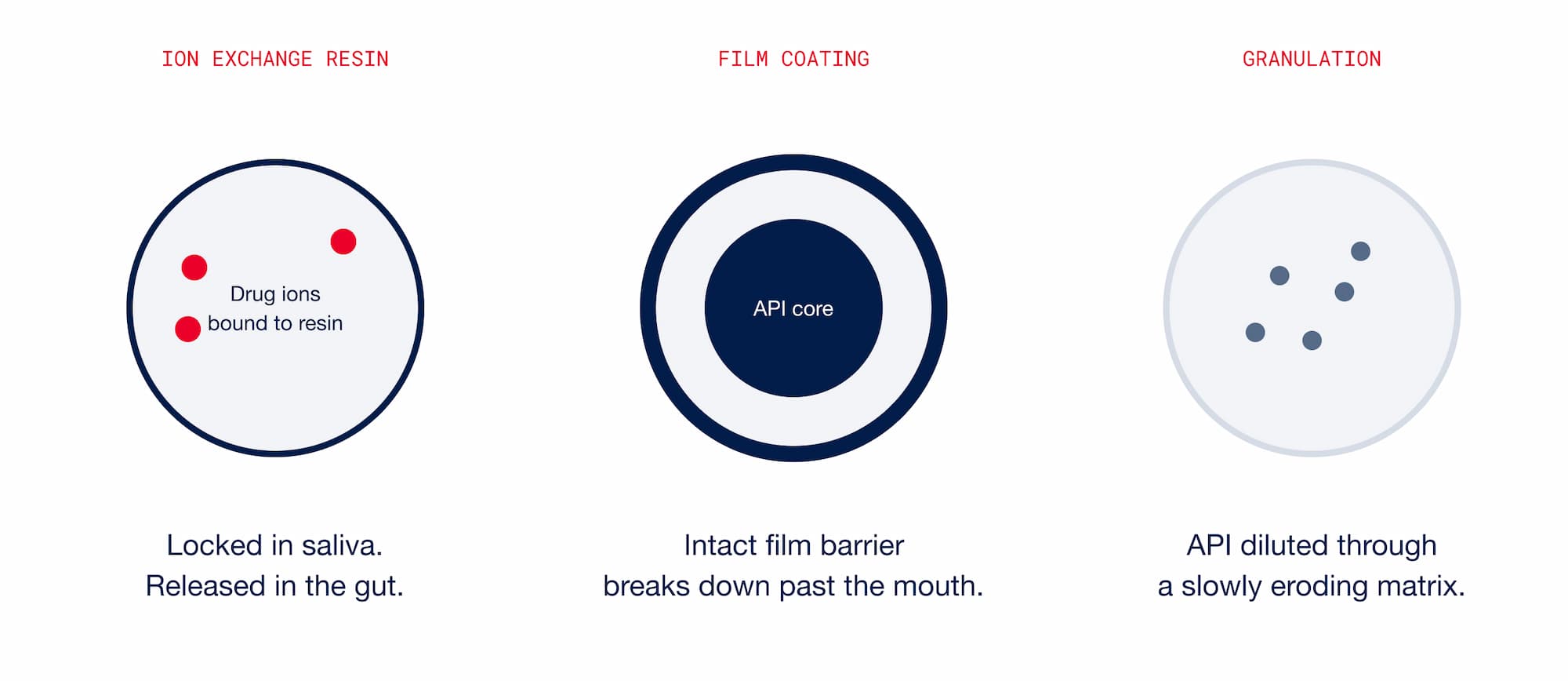
A resin carries a fixed electrical charge along its polymer backbone. An ionizable API with the opposite charge binds to the resin, forming a drug resin complex. In saliva, brief exposure and near neutral conditions keep that bond intact, so the bitter drug stays locked to the resin and never reaches taste receptors. In the stomach and intestine, a longer residence time and a very different ionic environment release the drug from the resin so absorption still happens normally.
Film coating.
A polymer film, drawn from the same family as pharmaceutical coating polymers used elsewhere in tablet manufacturing, is applied directly onto the drug particle or granule, physically separating it from saliva. The mechanism does not depend on the API's charge at all, since the coating works as a barrier rather than a chemical interaction. What matters instead is film integrity at two separate points. The coating needs to stay intact through manufacturing, particularly compression into a tablet. It also needs to reliably break down once past the mouth.
Granulation.
The API is embedded inside a granule matrix, often using hydrophobic excipients or a melt based process, so that drug dissolution is slowed during the short time the granule sits in the mouth. This is a physical dilution and delay strategy rather than a true barrier or binding mechanism, which generally makes it less effective for intensely bitter compounds but considerably simpler to produce.
What Determines Which Technique Will Actually Work
The API's ionization behavior is the first filter. A resin only works if the API carries a charge the resin can bind. A neutral or poorly ionizable molecule will not form a stable complex no matter how well suited the resin is chemically, which rules resins out immediately for a meaningful share of bitter compounds.
The dosage form is the second filter. Resins integrate naturally into liquid suspensions and syrups, where the drug resin complex simply stays dispersed until swallowed. Coated particles suit multiparticulate formats, orally disintegrating tablets and sprinkle formulations, where the coating needs to survive handling but not necessarily heavy compression force. Granulation fits sachets, chewables and formats where a simpler, lower cost process matters more than achieving the strongest possible taste block.
The intensity of the bitterness is the third filter. An intense bitter compound often needs the strongest masking available, typically resin binding or a robust coating, since granulation alone may not slow dissolution enough to keep the drug below the taste detection threshold during the mouth's brief exposure window.
Applications by Technique
Common Challenges
Assuming resin masking works regardless of the API.
A resin's performance depends entirely on the API carrying a usable charge. Teams that select a resin system before confirming the API's ionization profile sometimes discover, only after formulation work has started, that no meaningful complex forms.
Underestimating what compression does to a coating.
A film that masks taste perfectly on loose granules can crack during tablet compression, exposing the bitter core at the exact moment the tablet is meant to disintegrate in the mouth.
Expecting granulation to match resin or coating performance on intense bitterness.
Granulation is a useful technique in its own right, but it solves a different problem, moderate bitterness at lower cost, not the strongest possible taste block.
Choosing the technique before the dosage form is finalized.
A resin selected for a suspension does not transfer cleanly to a tablet program. A coating optimized for compression does not transfer cleanly to a liquid. The dosage form and the taste masking technique need to be decided together, not in sequence.
Formulation Insights
The API's ionization profile is worth confirming before any taste masking route is selected, not after. A quick check against the API's pKa and the pH conditions of saliva answers whether a taste masking resin is even mechanically possible before any development time is spent on it.
As a GMP excipient manufacturer and pharmaceutical excipient manufacturer in India, we supply materials across all three routes rather than pushing formulators toward whichever technique we happen to specialize in. Our taste masking coating polymer range and our ion exchange resin pharmaceutical grade materials are built for different mechanisms entirely. Matching the right grade to the actual dosage form matters more than the general technique category alone.
A cation exchange resin pharma teams reach for in a suspension format is a different starting point from a resin for oral suspension work that needs faster redispersion. Neither should be confused with the pharmaceutical coating polymers used in a compression sensitive tablet program, or with a taste masking coating system built specifically to survive that same compression step. We support this evaluation directly as a pharma raw material supplier in India. The functional excipients pharmaceutical formulators select for this decision, along with the taste masking techniques pharma teams compare them against, both deserve fresh scrutiny on each new API. A taste masking resin pharma teams relied on for one bitter compound is not a safe default for the next one without that check repeated.
FAQ
1. Can more than one taste masking technique be used on the same product?
Yes. Some formulations combine a resin complex with a light outer coating for additional protection, particularly when the API is both strongly ionizable and intensely bitter.
2. Does taste masking affect how quickly the drug is absorbed?
It can, depending on the technique and how it is executed. A well designed resin or coating system is built to release the drug fully and promptly once past the mouth, but a poorly optimized system can delay absorption in ways that were never intended.
3. Is granulation always the cheapest option?
Generally, yes, since it typically requires simpler equipment and fewer processing steps than resin complexation or film coating. Cost is not the only variable. A technique that fails to mask the taste adequately ends up costing more in reformulation than it saved upfront.
4. How is taste masking performance actually tested?
Through a combination of in vitro dissolution testing in simulated saliva conditions and human taste panel evaluation, since dissolution data alone does not always predict how a formulation will actually taste in the mouth.
5. What happens if the wrong technique is chosen for an API?
The masking either fails outright, leaving the bitter taste detectable, or it works inconsistently across batches. Both outcomes usually trace back to skipping the ionization and dosage form assessment before committing to a route.
Conclusion
Resins, coating and granulation are not interchangeable options ranked from best to worst. Each depends on a different property of the API and fits a different dosage form, which means the right choice is determined by the product's own chemistry and format rather than by which technique masks taste most aggressively in general. Confirming the API's ionization behavior and the intended dosage form before selecting a route avoids the rework that comes from discovering the mismatch after development has already started.
Talk to Us About Your Taste Masking Challenge.
Tell us about your API and its ionization profile along with the dosage form you are targeting. We will help you determine which route, or combination of routes, actually fits.
Write to us at contact@vikramthermo.com

Introduction
A bitter active ingredient does not become pleasant because a formulation is otherwise well designed. It becomes tolerable only if something physically or chemically stands between the drug and the tongue during the brief window before swallowing. Three techniques do this work in pharmaceutical formulations, ion exchange resins, film coating and granulation. Each solves the problem through a completely different mechanism.
Choosing between them is not a matter of picking whichever technique a formulator has used before. Each one depends on a different property of the API, works reliably with a different set of dosage forms and fails in a different way when applied to the wrong product. A resin that works beautifully for one bitter compound can do nothing at all for another, not because the resin is inferior, but because the underlying chemistry of the two APIs is not comparable.
At Vikram Thermo, we supply materials across all three routes, taste masking resin, functional coating polymer and granulation grade excipients. This article sets out how each technique actually works, what determines whether it will succeed on a specific API and how the three compare directly against each other.
How Each Technique Actually Works
Ion exchange resins.
A resin carries a fixed electrical charge along its polymer backbone. An ionizable API with the opposite charge binds to the resin, forming a drug resin complex. In saliva, brief exposure and near neutral conditions keep that bond intact, so the bitter drug stays locked to the resin and never reaches taste receptors. In the stomach and intestine, a longer residence time and a very different ionic environment release the drug from the resin so absorption still happens normally.
Film coating.
A polymer film, drawn from the same family as pharmaceutical coating polymers used elsewhere in tablet manufacturing, is applied directly onto the drug particle or granule, physically separating it from saliva. The mechanism does not depend on the API's charge at all, since the coating works as a barrier rather than a chemical interaction. What matters instead is film integrity at two separate points. The coating needs to stay intact through manufacturing, particularly compression into a tablet. It also needs to reliably break down once past the mouth.
Granulation.
The API is embedded inside a granule matrix, often using hydrophobic excipients or a melt based process, so that drug dissolution is slowed during the short time the granule sits in the mouth. This is a physical dilution and delay strategy rather than a true barrier or binding mechanism, which generally makes it less effective for intensely bitter compounds but considerably simpler to produce.
What Determines Which Technique Will Actually Work
The API's ionization behavior is the first filter. A resin only works if the API carries a charge the resin can bind. A neutral or poorly ionizable molecule will not form a stable complex no matter how well suited the resin is chemically, which rules resins out immediately for a meaningful share of bitter compounds.
The dosage form is the second filter. Resins integrate naturally into liquid suspensions and syrups, where the drug resin complex simply stays dispersed until swallowed. Coated particles suit multiparticulate formats, orally disintegrating tablets and sprinkle formulations, where the coating needs to survive handling but not necessarily heavy compression force. Granulation fits sachets, chewables and formats where a simpler, lower cost process matters more than achieving the strongest possible taste block.
The intensity of the bitterness is the third filter. An intense bitter compound often needs the strongest masking available, typically resin binding or a robust coating, since granulation alone may not slow dissolution enough to keep the drug below the taste detection threshold during the mouth's brief exposure window.
Applications by Technique
Common Challenges
Assuming resin masking works regardless of the API.
A resin's performance depends entirely on the API carrying a usable charge. Teams that select a resin system before confirming the API's ionization profile sometimes discover, only after formulation work has started, that no meaningful complex forms.
Underestimating what compression does to a coating.
A film that masks taste perfectly on loose granules can crack during tablet compression, exposing the bitter core at the exact moment the tablet is meant to disintegrate in the mouth.
Expecting granulation to match resin or coating performance on intense bitterness.
Granulation is a useful technique in its own right, but it solves a different problem, moderate bitterness at lower cost, not the strongest possible taste block.
Choosing the technique before the dosage form is finalized.
A resin selected for a suspension does not transfer cleanly to a tablet program. A coating optimized for compression does not transfer cleanly to a liquid. The dosage form and the taste masking technique need to be decided together, not in sequence.
Formulation Insights
The API's ionization profile is worth confirming before any taste masking route is selected, not after. A quick check against the API's pKa and the pH conditions of saliva answers whether a taste masking resin is even mechanically possible before any development time is spent on it.
As a GMP excipient manufacturer and pharmaceutical excipient manufacturer in India, we supply materials across all three routes rather than pushing formulators toward whichever technique we happen to specialize in. Our taste masking coating polymer range and our ion exchange resin pharmaceutical grade materials are built for different mechanisms entirely. Matching the right grade to the actual dosage form matters more than the general technique category alone.
A cation exchange resin pharma teams reach for in a suspension format is a different starting point from a resin for oral suspension work that needs faster redispersion. Neither should be confused with the pharmaceutical coating polymers used in a compression sensitive tablet program, or with a taste masking coating system built specifically to survive that same compression step. We support this evaluation directly as a pharma raw material supplier in India. The functional excipients pharmaceutical formulators select for this decision, along with the taste masking techniques pharma teams compare them against, both deserve fresh scrutiny on each new API. A taste masking resin pharma teams relied on for one bitter compound is not a safe default for the next one without that check repeated.
FAQ
1. Can more than one taste masking technique be used on the same product?
Yes. Some formulations combine a resin complex with a light outer coating for additional protection, particularly when the API is both strongly ionizable and intensely bitter.
2. Does taste masking affect how quickly the drug is absorbed?
It can, depending on the technique and how it is executed. A well designed resin or coating system is built to release the drug fully and promptly once past the mouth, but a poorly optimized system can delay absorption in ways that were never intended.
3. Is granulation always the cheapest option?
Generally, yes, since it typically requires simpler equipment and fewer processing steps than resin complexation or film coating. Cost is not the only variable. A technique that fails to mask the taste adequately ends up costing more in reformulation than it saved upfront.
4. How is taste masking performance actually tested?
Through a combination of in vitro dissolution testing in simulated saliva conditions and human taste panel evaluation, since dissolution data alone does not always predict how a formulation will actually taste in the mouth.
5. What happens if the wrong technique is chosen for an API?
The masking either fails outright, leaving the bitter taste detectable, or it works inconsistently across batches. Both outcomes usually trace back to skipping the ionization and dosage form assessment before committing to a route.
Conclusion
Resins, coating and granulation are not interchangeable options ranked from best to worst. Each depends on a different property of the API and fits a different dosage form, which means the right choice is determined by the product's own chemistry and format rather than by which technique masks taste most aggressively in general. Confirming the API's ionization behavior and the intended dosage form before selecting a route avoids the rework that comes from discovering the mismatch after development has already started.
Talk to Us About Your Taste Masking Challenge.
Tell us about your API and its ionization profile along with the dosage form you are targeting. We will help you determine which route, or combination of routes, actually fits.
Write to us at contact@vikramthermo.com

- Venue:
- Date:
- Booth:
- Time:
- Hosted by:
- Venue:
- Date:
- Booth:
- Time:
- Hosted by: