Insights from 40+ Years of Pharmaceutical Excipient Expertise at Vikram Thermo
INTRODUCTION
Sampling is not where excipient selection begins. It is where it ends.
Before a sample is requested, the formulation decision should already exist. Which mechanism does the product need. Which material family delivers it. Skipping that step does not save time. It moves the diagnostic work into the evaluation phase, where it costs considerably more.
At Vikram Thermo, we receive sample requests that include the formulation problem and sample requests that do not. The first kind get resolved quickly. The second require a conversation before any material is shipped, because sending the wrong grade helps no one. The wrong grade also creates a records trail in development that complicates the evaluation later.
This article outlines the shortlisting decision in practical terms, so the sample request you make maps to the problem you are actually trying to solve.
WHAT SHORTLISTING ACTUALLY INVOLVES
Shortlisting is not a supplier comparison exercise. It is a formulation decision.
Two questions sit at the centre of it. Which mechanism does this product need? Does this material family deliver it reliably in this manufacturing context? For a formulator working with a bitter API in a paediatric suspension, those questions have a specific answer. For a manufacturer scaling a 12-hour sustained release tablet, the answer is different. For a topical gel developer it is different again.
The goal is to arrive at those answers before committing a development team to a grade evaluation. Shortlisting does not reduce evaluation time. It reduces the number of evaluations that fail.
THE FOUR PRODUCT FAMILIES
Four distinct formulation functions account for the majority of enquiries we receive. Each maps to one product family.
DRUGCOAT® | Functional polymer coatings for solid oral forms
DRUGCOAT® is our pharmaceutical coating polymer range, built on methacrylic acid and methacrylate copolymer chemistries. It is the product family for formulators working on sustained release, enteric protection and immediate release applications that require a functional polymer barrier.
The key distinction within the range is pH-dependent behaviour. Our L and S Series polymers are designed for enteric coating applications, dissolving above pH 5.5 or pH 6.0 depending on grade, and S Series above pH 7.0. The RL and RS Series are designed for sustained release coating, where membrane permeability rather than dissolution controls drug release rate. The E Series dissolves below pH 5, which is the basis for taste masking in solid oral dosage forms.
If the formulator needs to control where or when a drug releases from a solid dosage form using a polymer film, DRUGCOAT® is the relevant family.
DRCOAT® | Ready-to-use aqueous coating systems
DRCOAT® is our ready-to-use tablet coating system range, based on HPMC and PVA film formers. It is designed for manufacturers who need a complete aqueous coating without building a formulation from polymer powder.
FCA and FCU grades cover immediate release applications. ECA and ECS cover enteric coating. The differentiation from DRUGCOAT® is not performance. It is process design. DRCOAT® systems disperse directly in water, with no solvent handling, no separate plasticiser addition and no colour blending step. They reduce process steps and formulation development time.
A manufacturer with established coating development capability may be suited to DRUGCOAT®. A manufacturer working with tighter timelines or limited coating experience may be better served by DRCOAT®. Neither is a compromise on the other.
APION® | Ion exchange resins for liquid and complex oral forms
APION® is our pharmaceutical grade ion exchange resin range. It is the product family for formulators working on oral suspensions, liquid oral generics, orally disintegrating tablets and chewable tablets where film coating cannot deliver the required mechanism.
Ion exchange resin complexation works through ionic binding between the drug and the resin particle. It functions in suspension without requiring a solid dosage form. That is the primary shortlisting filter. If the dosage form is liquid and the application is taste masking or controlled release, APION® is the relevant family. If the API carries no charge at physiological pH, ionic binding will not work and a different approach is needed.
Our APION® T Series handles taste masking in oral suspensions. The D Series addresses disintegration in solid forms. US DMF registration documentation is available at the shortlisting stage.
AQUAPOL® | Carbomer grades for gel and semi-solid forms
AQUAPOL® is our pharmaceutical carbomer range, covering gel-forming applications in topical, ophthalmic, nasal and oral liquid formats.
The relevant shortlisting decision within AQUAPOL® is viscosity grade, neutralisation requirement and the regulatory classification the intended market requires. AQUAPOL® is EXCiPACT GMP certified. US DMF registration is in place.
THE SHORTLISTING QUESTIONS
Before a sample request is submitted, four questions should have clear answers.
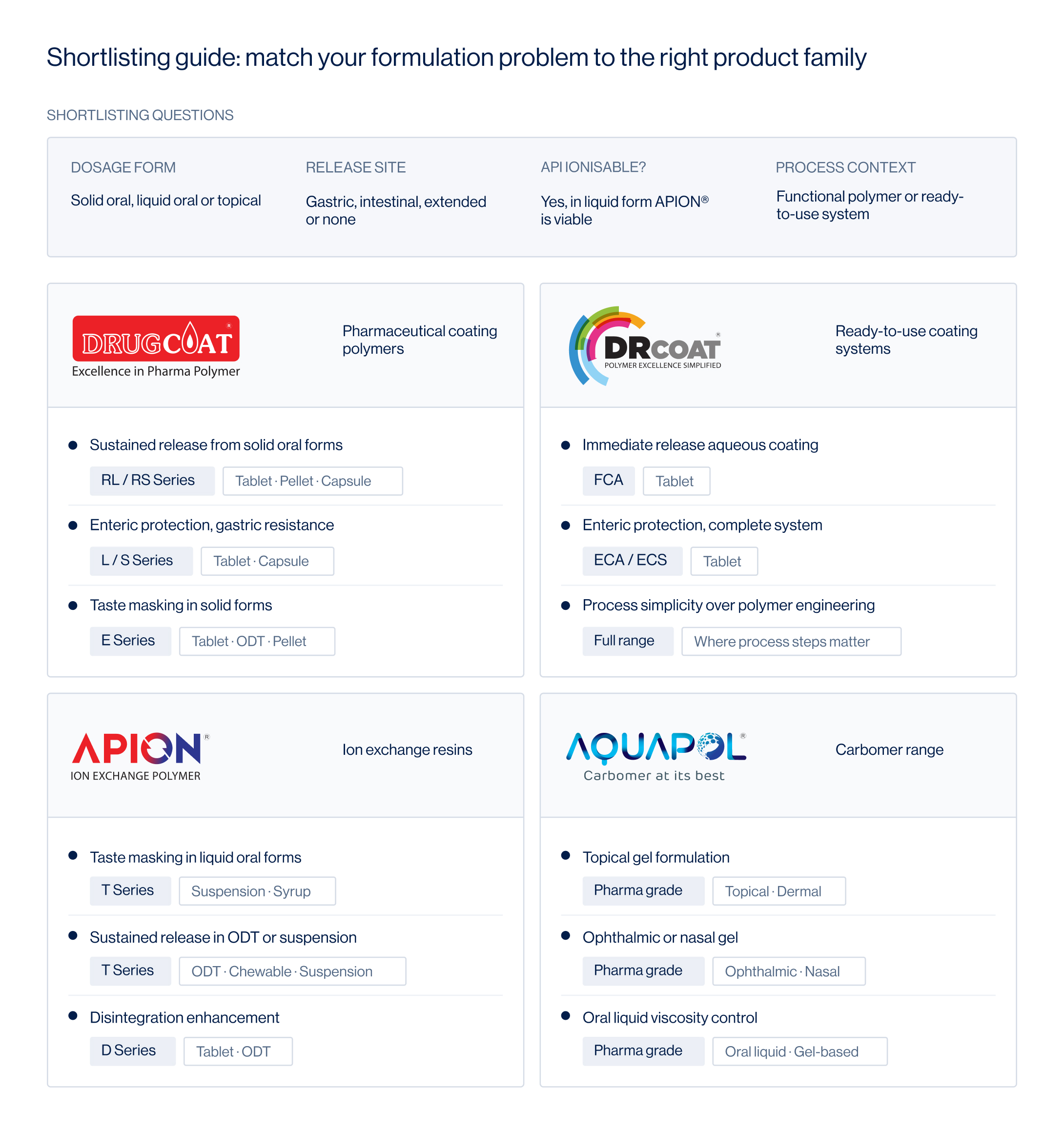
What is the dosage form? Liquid oral forms point to APION® for functional applications or DRCOAT® where aqueous film coating is involved. Solid oral forms sit within DRUGCOAT® or DRCOAT®. Topical and semi-solid work points to AQUAPOL®.
Where does the drug need to release? Gastric release at pH below 5 points to DRUGCOAT® E Series. Intestinal release above pH 5.5 or 7.0 points to DRUGCOAT® L or S Series or DRCOAT® ECA or ECS. Extended release over multiple hours points to DRUGCOAT® RL or RS. No modification required with an aqueous process points to DRCOAT® FCA or FCU.
Is the API ionisable? For taste masking or controlled release in a liquid form, ionisability determines whether APION® is viable at all. The answer rules the resin family in or out immediately.
What is the manufacturing context? Process capability, equipment type and development timeline all influence which family is the practical starting point. This is not always discussed in a sample request. It should be.
SHORTLISTING REFERENCE TABLE
COMMON SHORTLISTING ERRORS
The most frequent error we see is requesting the full product range. The intent is understandable: evaluate everything, then decide. What actually happens is that nothing gets evaluated properly. No material has been positioned against the specific requirement it was designed to meet.
A second error is specifying by competitor brand rather than by function. A formulator who asks for an Eudragit alternative or an Amberlite resin alternative receives the corresponding DRUGCOAT® or APION® grade. That is technically accurate. But a formulator who describes the release profile they need, the dosage form they are working with and the regulatory market they are targeting gives us enough to recommend the right grade, the right curing protocol and the right documentation package. The sample that comes out of that conversation succeeds more often than one based on a direct substitution.
Substitution starts from a product. Shortlisting starts from a formulation problem. The distinction matters in development.
A third error, less common but consequential: requesting a sample for a dosage form the product family cannot serve. An aqueous film coating polymer cannot taste-mask a liquid suspension. An ion exchange resin cannot bind a non-ionisable API. Screening for fit before sampling avoids both the wasted evaluation time and the incorrect conclusion that a material class does not work.
FREQUENTLY ASKED QUESTIONS
1. Can more than one product family be relevant to the same formulation?
Yes. A multi-particulate modified release product may use DRUGCOAT® RL or RS for the sustained release membrane and APION® for taste masking of a liquid component. The product families are not mutually exclusive. Each functional requirement is shortlisted independently.
2. Does DRCOAT® deliver the same dissolution performance as DRUGCOAT® functional polymers?
For enteric and sustained release applications, DRCOAT® systems are formulated and tested to deliver defined release profiles. The difference is not performance. DRCOAT® is a complete system; DRUGCOAT® is a functional excipient. A formulator working from DRUGCOAT® has more control over the release profile and more responsibility for the formulation. DRCOAT® trades that control for process simplicity.
3. What documentation is available before sampling?
Technical datasheets, CoAs, US DMF registration numbers, EXCiPACT GMP audit documentation and dissolution reference data are all available before a sample is requested. Curing protocol guidance is also provided as standard. We treat documentation as part of the shortlisting package.
4. The API in our formulation is poorly soluble. Does that affect which family is relevant?
Poorly soluble APIs need a solubilisation strategy before coating selection becomes the primary decision. If the API is BCS Class II or IV, the salt form or particle engineering approach should be defined first. Once the drug form is established, coating selection for release control or protection proceeds normally. We can discuss both stages.
5. Is a formal technical discussion required before a sample request?
Not required. But requests that arrive with a clear formulation context (dosage form, release target, target market) consistently reach a usable result faster than those that do not.
CONCLUSION
Forty years of excipient development conversations have produced one consistent observation. The formulators who reach commercial manufacturing most efficiently know what they need before they ask for a sample.
The product families in our range address distinct formulation problems. DRUGCOAT® for polymer film control of drug release from solid forms. DRCOAT® for complete aqueous coating systems. APION® for ionic complexation in liquid and ODT forms. AQUAPOL® for gel and semi-solid applications. Matching the problem to the family is the work that shortlisting does. It takes one conversation.
We are India's first EXCiPACT GMP-certified polymer excipient manufacturer. US DMF registration and WHO cGMP compliance are in place across the full range.
Shortlisting Before Sampling? Talk to Us.
Tell us the formulation problem. We will tell you which product family applies, which grades are relevant to your process and what documentation you need before evaluation begins. That conversation takes less time than a failed sample evaluation.
Write to us at contact@vikramthermo.com

Insights from 40+ Years of Pharmaceutical Excipient Expertise at Vikram Thermo
INTRODUCTION
Sampling is not where excipient selection begins. It is where it ends.
Before a sample is requested, the formulation decision should already exist. Which mechanism does the product need. Which material family delivers it. Skipping that step does not save time. It moves the diagnostic work into the evaluation phase, where it costs considerably more.
At Vikram Thermo, we receive sample requests that include the formulation problem and sample requests that do not. The first kind get resolved quickly. The second require a conversation before any material is shipped, because sending the wrong grade helps no one. The wrong grade also creates a records trail in development that complicates the evaluation later.
This article outlines the shortlisting decision in practical terms, so the sample request you make maps to the problem you are actually trying to solve.
WHAT SHORTLISTING ACTUALLY INVOLVES
Shortlisting is not a supplier comparison exercise. It is a formulation decision.
Two questions sit at the centre of it. Which mechanism does this product need? Does this material family deliver it reliably in this manufacturing context? For a formulator working with a bitter API in a paediatric suspension, those questions have a specific answer. For a manufacturer scaling a 12-hour sustained release tablet, the answer is different. For a topical gel developer it is different again.
The goal is to arrive at those answers before committing a development team to a grade evaluation. Shortlisting does not reduce evaluation time. It reduces the number of evaluations that fail.
THE FOUR PRODUCT FAMILIES
Four distinct formulation functions account for the majority of enquiries we receive. Each maps to one product family.
DRUGCOAT® | Functional polymer coatings for solid oral forms
DRUGCOAT® is our pharmaceutical coating polymer range, built on methacrylic acid and methacrylate copolymer chemistries. It is the product family for formulators working on sustained release, enteric protection and immediate release applications that require a functional polymer barrier.
The key distinction within the range is pH-dependent behaviour. Our L and S Series polymers are designed for enteric coating applications, dissolving above pH 5.5 or pH 6.0 depending on grade, and S Series above pH 7.0. The RL and RS Series are designed for sustained release coating, where membrane permeability rather than dissolution controls drug release rate. The E Series dissolves below pH 5, which is the basis for taste masking in solid oral dosage forms.
If the formulator needs to control where or when a drug releases from a solid dosage form using a polymer film, DRUGCOAT® is the relevant family.
DRCOAT® | Ready-to-use aqueous coating systems
DRCOAT® is our ready-to-use tablet coating system range, based on HPMC and PVA film formers. It is designed for manufacturers who need a complete aqueous coating without building a formulation from polymer powder.
FCA and FCU grades cover immediate release applications. ECA and ECS cover enteric coating. The differentiation from DRUGCOAT® is not performance. It is process design. DRCOAT® systems disperse directly in water, with no solvent handling, no separate plasticiser addition and no colour blending step. They reduce process steps and formulation development time.
A manufacturer with established coating development capability may be suited to DRUGCOAT®. A manufacturer working with tighter timelines or limited coating experience may be better served by DRCOAT®. Neither is a compromise on the other.
APION® | Ion exchange resins for liquid and complex oral forms
APION® is our pharmaceutical grade ion exchange resin range. It is the product family for formulators working on oral suspensions, liquid oral generics, orally disintegrating tablets and chewable tablets where film coating cannot deliver the required mechanism.
Ion exchange resin complexation works through ionic binding between the drug and the resin particle. It functions in suspension without requiring a solid dosage form. That is the primary shortlisting filter. If the dosage form is liquid and the application is taste masking or controlled release, APION® is the relevant family. If the API carries no charge at physiological pH, ionic binding will not work and a different approach is needed.
Our APION® T Series handles taste masking in oral suspensions. The D Series addresses disintegration in solid forms. US DMF registration documentation is available at the shortlisting stage.
AQUAPOL® | Carbomer grades for gel and semi-solid forms
AQUAPOL® is our pharmaceutical carbomer range, covering gel-forming applications in topical, ophthalmic, nasal and oral liquid formats.
The relevant shortlisting decision within AQUAPOL® is viscosity grade, neutralisation requirement and the regulatory classification the intended market requires. AQUAPOL® is EXCiPACT GMP certified. US DMF registration is in place.
THE SHORTLISTING QUESTIONS
Before a sample request is submitted, four questions should have clear answers.
What is the dosage form? Liquid oral forms point to APION® for functional applications or DRCOAT® where aqueous film coating is involved. Solid oral forms sit within DRUGCOAT® or DRCOAT®. Topical and semi-solid work points to AQUAPOL®.
Where does the drug need to release? Gastric release at pH below 5 points to DRUGCOAT® E Series. Intestinal release above pH 5.5 or 7.0 points to DRUGCOAT® L or S Series or DRCOAT® ECA or ECS. Extended release over multiple hours points to DRUGCOAT® RL or RS. No modification required with an aqueous process points to DRCOAT® FCA or FCU.
Is the API ionisable? For taste masking or controlled release in a liquid form, ionisability determines whether APION® is viable at all. The answer rules the resin family in or out immediately.
What is the manufacturing context? Process capability, equipment type and development timeline all influence which family is the practical starting point. This is not always discussed in a sample request. It should be.
SHORTLISTING REFERENCE TABLE
COMMON SHORTLISTING ERRORS
The most frequent error we see is requesting the full product range. The intent is understandable: evaluate everything, then decide. What actually happens is that nothing gets evaluated properly. No material has been positioned against the specific requirement it was designed to meet.
A second error is specifying by competitor brand rather than by function. A formulator who asks for an Eudragit alternative or an Amberlite resin alternative receives the corresponding DRUGCOAT® or APION® grade. That is technically accurate. But a formulator who describes the release profile they need, the dosage form they are working with and the regulatory market they are targeting gives us enough to recommend the right grade, the right curing protocol and the right documentation package. The sample that comes out of that conversation succeeds more often than one based on a direct substitution.
Substitution starts from a product. Shortlisting starts from a formulation problem. The distinction matters in development.
A third error, less common but consequential: requesting a sample for a dosage form the product family cannot serve. An aqueous film coating polymer cannot taste-mask a liquid suspension. An ion exchange resin cannot bind a non-ionisable API. Screening for fit before sampling avoids both the wasted evaluation time and the incorrect conclusion that a material class does not work.
FREQUENTLY ASKED QUESTIONS
1. Can more than one product family be relevant to the same formulation?
Yes. A multi-particulate modified release product may use DRUGCOAT® RL or RS for the sustained release membrane and APION® for taste masking of a liquid component. The product families are not mutually exclusive. Each functional requirement is shortlisted independently.
2. Does DRCOAT® deliver the same dissolution performance as DRUGCOAT® functional polymers?
For enteric and sustained release applications, DRCOAT® systems are formulated and tested to deliver defined release profiles. The difference is not performance. DRCOAT® is a complete system; DRUGCOAT® is a functional excipient. A formulator working from DRUGCOAT® has more control over the release profile and more responsibility for the formulation. DRCOAT® trades that control for process simplicity.
3. What documentation is available before sampling?
Technical datasheets, CoAs, US DMF registration numbers, EXCiPACT GMP audit documentation and dissolution reference data are all available before a sample is requested. Curing protocol guidance is also provided as standard. We treat documentation as part of the shortlisting package.
4. The API in our formulation is poorly soluble. Does that affect which family is relevant?
Poorly soluble APIs need a solubilisation strategy before coating selection becomes the primary decision. If the API is BCS Class II or IV, the salt form or particle engineering approach should be defined first. Once the drug form is established, coating selection for release control or protection proceeds normally. We can discuss both stages.
5. Is a formal technical discussion required before a sample request?
Not required. But requests that arrive with a clear formulation context (dosage form, release target, target market) consistently reach a usable result faster than those that do not.
CONCLUSION
Forty years of excipient development conversations have produced one consistent observation. The formulators who reach commercial manufacturing most efficiently know what they need before they ask for a sample.
The product families in our range address distinct formulation problems. DRUGCOAT® for polymer film control of drug release from solid forms. DRCOAT® for complete aqueous coating systems. APION® for ionic complexation in liquid and ODT forms. AQUAPOL® for gel and semi-solid applications. Matching the problem to the family is the work that shortlisting does. It takes one conversation.
We are India's first EXCiPACT GMP-certified polymer excipient manufacturer. US DMF registration and WHO cGMP compliance are in place across the full range.
Shortlisting Before Sampling? Talk to Us.
Tell us the formulation problem. We will tell you which product family applies, which grades are relevant to your process and what documentation you need before evaluation begins. That conversation takes less time than a failed sample evaluation.
Write to us at contact@vikramthermo.com
.jpg)
.jpg)
- Venue:
- Date:
- Booth:
- Time:
- Hosted by:
- Venue:
- Date:
- Booth:
- Time:
- Hosted by: